
5-4-3-2-1 grounding technique: steps and an example
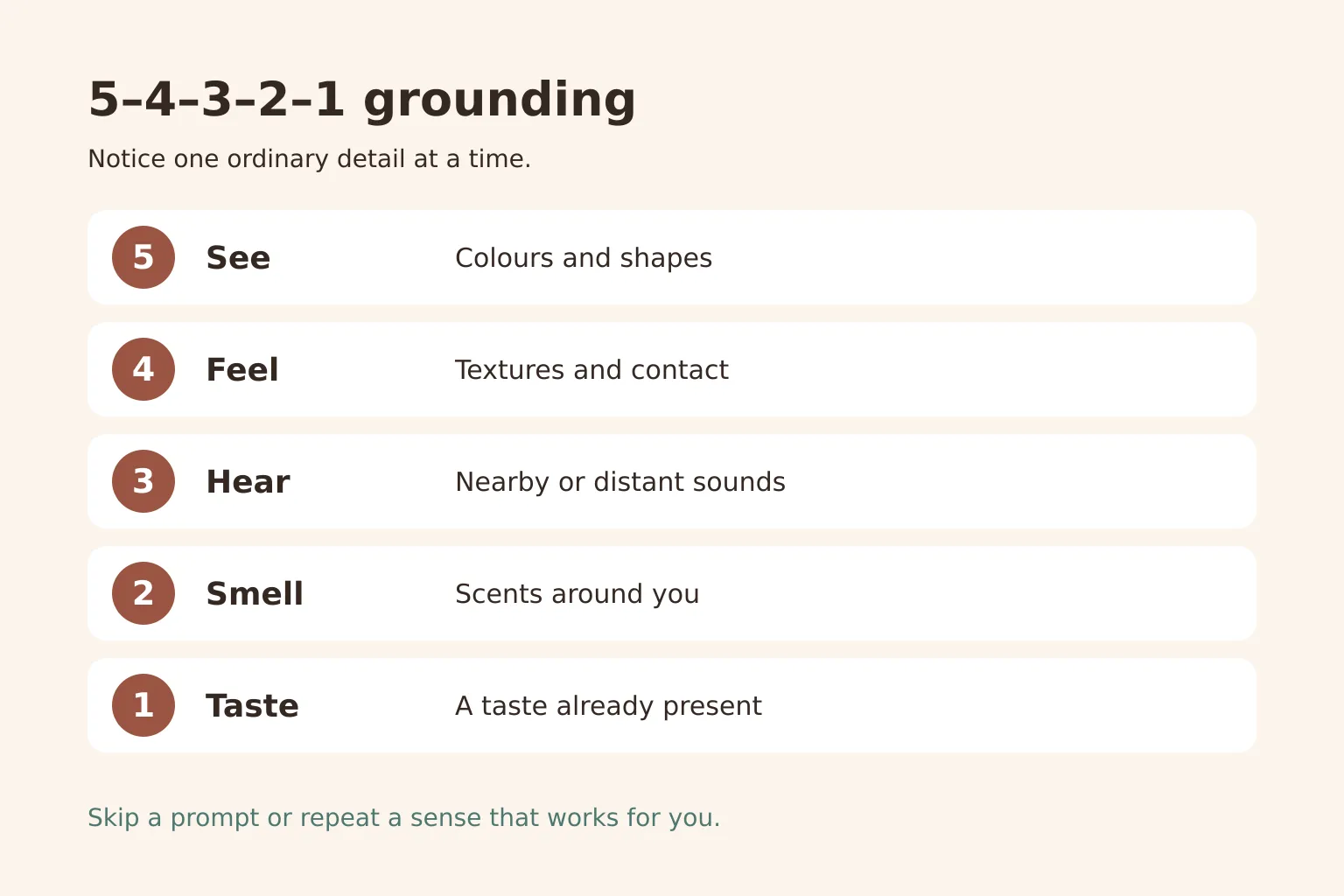
The 5-4-3-2-1 grounding technique asks you to notice five things you can see, four you can feel, three you can hear, two you can smell and one you can taste. It brings your attention to details around you when anxious thoughts feel overwhelming. Start somewhere you can safely pause, move at your own pace, and skip a sense if it isn't accessible or feels uncomfortable.
How to do the 5-4-3-2-1 grounding technique
Grounding means directing your attention to the present, often through your senses. NHS inform's grounding guidance, updated in December 2025, describes this five-senses sequence as an option for overwhelming anxiety and stress.
Get somewhere you can safely sit or stand. Don't try the exercise while driving or doing something that needs your full attention. You can breathe naturally; there's no need to force a large breath before beginning.
- See five things. Look for small details: a colour, a shadow, a line in the floor or the edge of a book.
- Feel four things. Notice physical contact, such as your feet against the floor, clothing on your arm or the texture of a safe object. Here, “feel” means touch, rather than naming four emotions.
- Hear three things. Notice sounds already present. They might be close by or farther away.
- Smell two things. Notice familiar, comfortable scents around you. You don't need to seek out a strong smell.
- Taste one thing. Notice a taste already in your mouth. You don't need to eat anything to complete the exercise.
You can name the details silently. Pause long enough to notice each one rather than racing through a list.
A worked example at your desk
Say you've sent an email and keep replaying how it might have sounded. You decide to take a sensory pause before rereading it again. Your observations might look like this:
| Step | Details you notice |
|---|---|
| Five things you see | A white mug, a blue pen, the corner of your screen, a stripe of sunlight, a leaf on a plant |
| Four things you feel | Your feet in your shoes, the chair under you, your sleeve against your wrist, the smooth desk beneath your fingertips |
| Three things you hear | A fan, footsteps outside, a bird near the window |
| Two things you smell | Tea in your mug, a faint scent of hand soap |
| One thing you taste | A trace of mint from earlier |
The email is still there. The exercise gives you something else to attend to for a moment; it doesn't decide whether the email needs a reply. Afterward, choose one practical next step, such as returning to a task or checking the email once if there's a specific detail to verify.
What if you can't find a smell or taste?
If a sense isn't accessible, or there simply isn't much to notice, skip that step or return to a sense that works for you. For example, look for two more shapes instead of two smells. You don't need to get up and search for something to make the count exact.
Keep touch prompts comfortable and ordinary. If paying attention to your body feels unpleasant, you could focus on the texture of an object instead, or stay with sights and sounds. Stop if the exercise makes you feel worse.
What if your mind keeps wandering?
When you notice that you've returned to the worry, pick the next detail around you. You don't have to restart from five or push the thought away before continuing.
A useful description can be very small: “The mug's handle is curved” gives your attention more to work with than “mug.” But if detailed descriptions feel like extra work, simple names are enough.
Avoid turning the exercise into a test of whether you're calm yet. You may still feel anxious at the end. There's no required number of rounds and no need to repeat it until you reach a particular feeling.
When to seek human support
Grounding is a self-help option, not a substitute for therapy or emergency care. If anxiety keeps returning, affects sleep or daily life, or these pauses aren't enough, speak with a qualified mental-health professional or your usual healthcare provider about support for your situation. If you feel unsafe or need urgent help, contact local emergency services or a crisis service; the site's urgent-support page lists options.